

UK Reggae and Reggae Culture
When reggae comes up in conversation, Jamaica is usually the first place that pops into people’s minds. But what often gets missed is how this genre has truly taken root in other parts of the world—especially in Britain.
UK Reggae isn’t just a replica of Jamaican sounds shipped over the ocean; it has evolved into something uniquely its own, influenced by migration, racism, resilience, and a deep yearning for belonging.
The basslines may have originated in Kingston, but the vibes are unmistakably British.


The Arrival: Jamaican Migration and the Foundation of a Community
After the Second World War, Britain was in dire need of workers to help rebuild its bombed cities, manage transport systems, and keep hospitals running. That’s when the Windrush Generation made their way over—thousands of Caribbean men and women, many hailing from Jamaica, arriving in what they were told was the “Mother Country.” The iconic ship Empire Windrush docked at Tilbury in 1948, marking just the start of years of migration.
For many, the reality of Britain was far from welcoming. Instead of the opportunities they had hoped for, they faced racism in housing, jobs, and even on the streets. The painful memories of “No Blacks, No Dogs, No Irish” signs still linger for those who experienced it. In such a harsh environment, community became essential. Music played a crucial role in that survival—serving as a way to carry a piece of home with you.
If you were Jamaican in post-war England, you craved the latest ska, rocksteady, and eventually reggae records. You wanted to feel the bass reverberate through the walls just like it did back in Kingston. This wasn’t just about entertainment; it was about identity, resistance, and comfort.

Sound Systems as a Lifeline: Recreating Home in the UK
For many immigrants, putting together a sound system was about more than just having fun — it was a matter of survival. Just like back in Jamaica, these sound systems became the very heart of community life. Speakers, turntables, and amplifiers were hauled into basements and rented halls, giving rise to blues parties and shebeens — those unofficial clubs often set up in private homes, where you’d sneak in through the back door and try to avoid the police.
By the late 1960s and into the 70s, neighborhoods in Birmingham, Brixton, and Handsworth were alive with these vibrant gatherings. Initially, the music was imported, shipped from Kingston on delicate vinyl records. Crews would compete to showcase the freshest dub plates or the rarest cuts of dub reggae. But as the community expanded, so did their creativity.
Sound systems evolved into more than just parties, they became vital public forums. Figures like Jah Shaka weren’t just entertainers — they were the voices of the community.
Channel One Sound System, which is still going strong today, stands as another testament to this legacy.
Beyond reggae, these crews laid the groundwork for British youth culture.
👉 For more on the Jamaican roots of this tradition, check out our article Jamaican Sound Systems: How Jamaican Toasting & DJ Culture Conquered the World.



Forging a Unique Sound: From Import to Innovation
Early Days: Importing the Latest Tunes
In the beginning, UK Reggae was all about bringing the vibrant sounds of Jamaica to Britain in their most authentic form. Shop owners in London and Birmingham would eagerly await the arrival of crates filled with 7-inch singles shipped straight from Kingston. Collectors still reminisce about the excitement of lining up at places like Peckings in Shepherd’s Bush, just to snag the latest Studio One release.
But there were challenges; shipping delays meant that by the time a record finally made it to London, Jamaicans back home had already moved on to the next big thing. Audiences, along with British DJs hungry for fresh sounds, craved something more immediate, and those shipping delays opened the door for innovation.
The Rise of UK Dub and Producers
This is where British producers and engineers stepped in. Many were first- or second-generation Jamaicans who began crafting their own music. Dub was the perfect playground for experimentation, with its echoing spaces and deep bass lines. Pioneers like Mad Professor and Dennis Bovell played a crucial role in transforming reggae from a Jamaican import into a uniquely British phenomenon.
In the hazy studios scattered across London, they tinkered with tape machines, played around with reverb, and created tracks that matched the raw energy of Jamaican dub while adding their own twist. It was in these creative spaces that dub reggae began to merge with the burgeoning electronic scene, laying the groundwork for what would eventually evolve into jungle and drum & bass.
Lovers Rock: A British Innovation

Not all UK Reggae was about heavy bass lines or militant messages. In the mid-1970s, a softer, more romantic sound began to take shape: Lovers Rock. This sub-genre, which originated in South London, focused on melody, smooth rhythms, and love-themed lyrics instead of political ones.
Artists like Janet Kay, known for her hit “Silly Games,” and Carroll Thompson produced songs that struck a chord with communities, especially young Black British women who had often felt overlooked in the reggae scene.
Lovers Rock was a uniquely British creation, blending Caribbean heritage with the UK’s musical landscape by incorporating soul influences alongside Jamaican reggae beats.
While some might label it as “lightweight” compared to the more militant roots reggae, Lovers Rock held its own quiet strength, providing a sense of affirmation and joy in a world where daily life could be tough.

More Than Music: Reggae and British Black Identity
To view reggae in Britain merely as entertainment would completely overlook its deeper significance. This genre served as the soundtrack for resistance. During the 1970s, when the National Front marched and police enforced “sus laws” to stop and search young Black men, reggae was there to channel the collective anger. Steel Pulse, a reggae collective from Birmingham, released “Ku Klux Klan” — a powerful condemnation of racism that still resonates today. Their music was more than just catchy beats; it was a form of testimony.
Voice of Resistance
The very bassline could resonate with defiance. The lyrics boldly addressed issues like injustice, colonialism, and the challenges of being Black in Britain. Tracks like Aswad’s “African Children” and Linton Kwesi Johnson’s dub poetry encapsulated both fury and hope. If punk was all about screaming, reggae had a steady pulse.
Cultural Expression
Simultaneously, reggae emerged as a vibrant celebration of identity. Dancing at a blues party wasn’t just about having a good time — it was about claiming a place in a society that often marginalized Black communities. Jamaican patois mixed with London slang, creating a unique cultural blend. Even now, if you stroll through Brixton Market, the sounds of reggae can be heard echoing from the stalls, serving as a reminder of those formative years.
Notting Hill Carnival
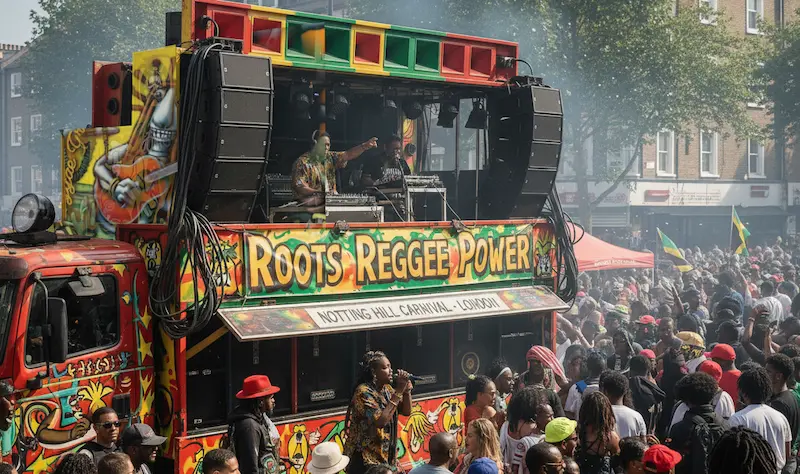
Nothing captures this spirit better than the Notting Hill Carnival. Born from the Caribbean communities’ desire to assert their presence, it has grown into Europe’s largest street festival. Steel bands, reggae artists, and sound systems transform the streets into a lively celebration of Caribbean culture.
👉 Visit the official Notting Hill Carnival website to learn more about the history of the event.
Crossover Appeal: Two-Tone Ska and Beyond
Two-Tone Ska
By the late 1970s, reggae was starting to make waves in other youth cultures. The raw energy of punk, paired with its strong anti-racist message, blended seamlessly with Jamaican ska rhythms, giving rise to the Two-Tone Ska movement, which was a uniquely British phenomenon.
Bands like The Specials, Madness, and The Selecter may not have been Jamaican, but they embodied the essence of UK Reggae, helping to shape a vibrant, multiracial scene.
The iconic black-and-white Two-Tone logo wasn’t just for show — it was a powerful statement. This music created a rare space of unity in places like Coventry, where racial tensions were high and unemployment loomed large.
👉 For ska’s Jamaican roots, check out The Evolution of Reggae: From Jamaican Streets to a Worldwide Sound
Influence on Electronic Music
Reggae has left its mark all over British electronic music. In the 1990s, genres like jungle and drum & bass drew heavily from the deep basslines and vibrant sound system culture of dub reggae. Even grime, with its unique MC style and powerful beats, pays homage to the toasting techniques of reggae DJs. And let’s not forget about today’s dubstep — which emerged from the underground scenes of South London — that simply wouldn’t have come to life without the groundbreaking low-end experiments of early UK dub producers.

The Living Legacy: UK Reggae Today
So, what’s the deal with reggae today? Some folks might think it’s stuck in the 70s, but UK reggae is very much alive and kicking. Channel One is still out there touring the globe with their legendary sound system. And let’s not forget Steel Pulse, who keeps bridging the gap between generations with their performances. Younger talents like Maxi Priest and Hollie Cook are stepping up to carry the torch — a clear sign that the legacy of English reggae artists is thriving.
Festivals like Reggae Land in Milton Keynes and the One Love Festival are keeping reggae at the heart of British summer culture. If you take a look at online reggae sites or flip through a reggae magazine, you’ll see that UK artists are well-represented.
Interestingly, the way fans hunt for records has changed. Gone are the days when people would line up outside record shops for rare dub reggae tracks; now, many are on the lookout for reggae music online. Still, vinyl collectors will tell you that nothing beats the thrill of digging through second-hand shops in Brixton or Soho.

Conclusion: A Persistent Bassline in the Cultural Fabric of the United Kingdom
The tale of UK Reggae is really about finding a sense of belonging. It all started with migrants yearning to recreate the sounds of their homeland, which blossomed into vibrant communities, unique identities, and diverse subgenres. This genre ignited intercultural creativity, gave voice to resistance, and continues to shape British culture even today.
From the sweet melodies of Lovers Rock to the powerful messages of Steel Pulse, and from Jah Shaka’s deep dub sessions to the lively atmosphere of Notting Hill Carnival, reggae has always been more than just background music. It acts as a teacher and a grounding force, reminding us that our identities can be both inherited and crafted.
Some may say that reggae in England is overshadowed by its Jamaican roots. But if you take a closer look, you’ll discover a rich, vibrant legacy. The bassline that originated in Kingston now resonates just as strongly in Birmingham, Brixton, and beyond. UK Reggae isn’t merely an import — it’s woven into the very heartbeat of Britain.
FAQs About UK Reggae
Who started UK reggae?
There isn’t just one person to credit with its beginnings. Early trailblazers like Count Suckle in London and sound system operators in Birmingham were instrumental in shaping the scene during the 1960s. Later on, artists such as Steel Pulse, Aswad, and Linton Kwesi Johnson took it to a global stage.
What is Lovers Rock music?
Lovers Rock is a unique sub-genre of UK Reggae that popped up in South London around the mid-1970s. With stars like Janet Kay and Carroll Thompson leading the way, it’s known for its smooth, melodic sound and focuses on themes of love and relationships.
What is the difference between UK reggae and Jamaican reggae?
Jamaican reggae is the original, deeply rooted in Kingston’s studios and Rastafarian culture. UK reggae, while drawing inspiration from that foundation, evolved to reflect British experiences — including racism, identity challenges, and cultural exchanges. It played a crucial role in shaping Black British identity and gave rise to distinct sounds like Lovers Rock.
Which English reggae artist became most famous internationally?
Steel Pulse rose to international fame with their politically charged albums, like Handsworth Revolution. Maxi Priest also made waves globally, blending reggae with pop and R&B influences.
